
Are all Pinless Moisture Meters Created Equal?
With so many pinless wood moisture meters on the market, it’s hard to know which one is the easiest to operate and the most accurate. When your reputation depends on the success rate of your flooring or woodworking projects, your moisture meter needs to provide you with accurate readings you can count on. False readings that are caused by inferior products are not acceptable.
Below, we have compared the features, benefits, and reviews (when available) of some of the most popular brands and devices that are available on the market. We hope this information will provide you with unbiased knowledge that will help you decide which moisture meter is the best fit for you.

Wagner Moisture Meter Models
Orion 910 Deep Depth Moisture Meter
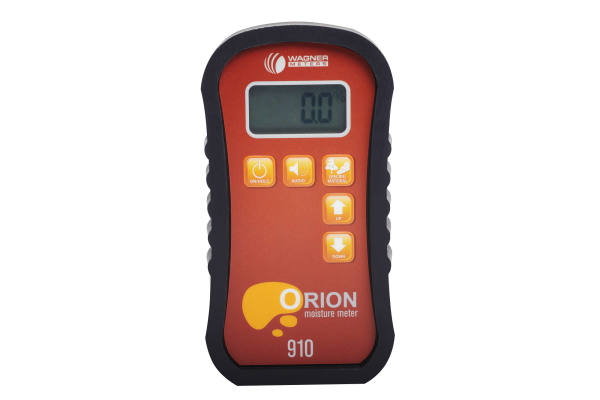
The Orion® 910 Deep Depth Pinless Wood Moisture Meter Kit continues the Wagner tradition of superior accuracy and adds incredible new functionality. The new Orion 910 meter incorporates IntelliSense™ technology, a more rugged design, and industry-exclusive true in-the-field calibration capability provided by the included On-Demand Calibrator.
Price: $379
Orion 910 Kit Includes:
- Orion 910 Wood Moisture Meter
- Paired On-Demand Calibrator
- Rubber Protective Boot
- Foam-lined ABS Plastic Carrying Case
- 9V Battery
- Species Settings Booklet
- Instruction Manual
- Common Flooring Materials Settings Reference Card
Amazon User Reviews
5.0 out of 5 stars Simple, Effective, a Breeze to Use – 5.0 out of 5 stars
Reviewed in the United States on June 5, 2019
Recently purchased this moisture meter, after reading a substantial number of reviews and comparisons between different meters and option for measuring the drying of hardwood lumber for woodworking. Comes well packaged and padded in its own hard plastic case, which includes the wood specific density guide, instructions and a device specific calibration plate. Took it out for measurements over the past couple of days to my piles of hard maple, walnut, oak, hickory and cherry, and a few home center 2x4s and had measurements done promptly, accurately (based on what I knew about the lumbers age and drying history), and easily – a real breeze to use. Very happy with how simple it is to change to specific density to adjust between species and I can see this being an asset to my lumber purchases for years to come.
No Holes in your wood – 5.0 out of 5 stars
Reviewed in the United States on March 30, 2020
I was tired of poking holes in wood to see what the moisture content was. This made life easy. It came in and went all of my shop and outside wood storage checking moisture. Much improved over the old method. Ok, it is expensive but I think it was worth it.
Orion 920 Shallow Depth Moisture Meter
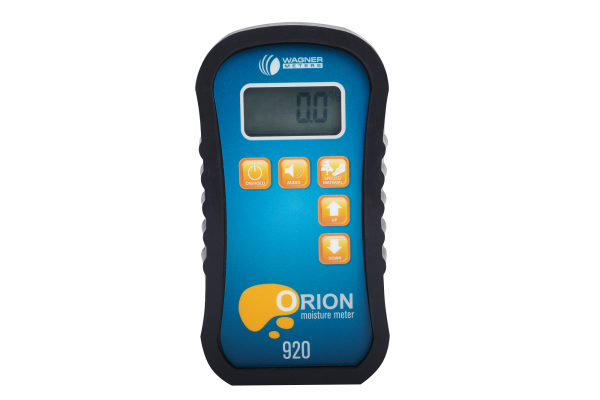
The Orion 920 Shallow Depth Pinless Wood Moisture Meter Kit features the Orion 920 meter designed exclusively for shallow measurement of moisture content from the surface down to .25” (6.4mm) deep inside wood or other material. Ideal for applications where accurate moisture readings from thin wood pieces or coatings are critical to success.
Price: $379
Orion 920 Kit Includes:
- Orion 920 Wood Moisture Meter
- Paired On-Demand Calibrator
- Rubber Protective Boot
- Foam-lined ABS Plastic Carrying Case
- 9V Battery
- Species Settings Booklet
- Instruction Manual
- Common Flooring Materials Settings Reference Card
Amazon User Reviews
Good meter – 5.0 out of 5 stars
Reviewed in the United States on June 7, 2020
I operate a wood flooring business and job site as well as product moisture levels are extremely important to the success or failure of a job. This meter allows a quick non-invasive way of monitoring those levels. I have used Wagner’s pinless moisture meters in the past and have been very satisfied with their product’s.
Orion 930 Dual Depth Moisture Meter
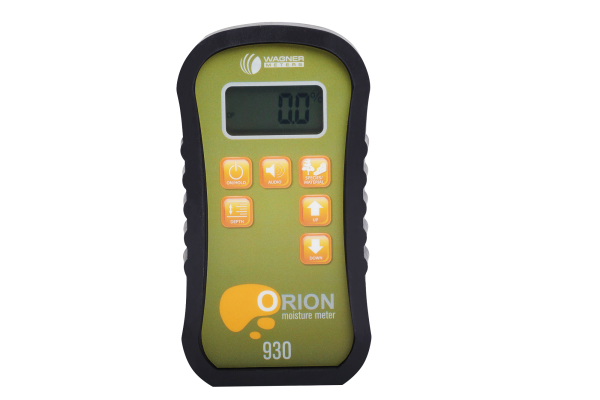
The Orion 930 Dual Depth Pinless Wood Moisture Meter Kit features the Orion 930 meter, designed for measurement of moisture content from the surface down to .25” (6.4mm) or .75” (19mm) deep inside wood or other material. The Orion 930 Dual Depth Moisture Meter features the versatility that is needed for flooring, quality control, woodworking, and inspection applications.
Price: $429
Orion 930 Kit Includes:
- Orion 930 Wood Moisture Meter
- Paired On-Demand Calibrator
- Rubber Protective Boot
- Foam-lined ABS Plastic Carrying Case
- 9V Battery
- Species Settings Booklet
- Instruction Manual
- Common Flooring Materials Settings Reference Card
Amazon User Reviews
Great product and great support – 5.0 out of 5 stars
Reviewed in the United States on February 16, 2019
I had a slow dishwasher leak in the kitchen and had to tear up a large section of the maple flooring. I bought this meter to be certain I had everything dried out and that the moisture content of the underlayment and new flooring had sufficiently balanced before I began installation of the new floor. I had a question on using the meter in Relative mode and also over USB, so I emailed support at Wagner meters. I also mentioned the manual was a little lacking in the Relative mode section. The very next day I received an in-depth reply. They even noted my comment on the section that was lacking in the manual. Here was Tony’s response: “You are quite right about the explanation on how to use the Relative mode. I appreciate your bringing this to my attention. I have made a recommendation to amend the manual.” Needless to say, I was very pleased with both the product and the support.
Great meter, fantastic Tech Support – 5.0 out of 5 stars
Reviewed in the United States on April 1, 2021
This meter is far easier and faster to use than my old pin-type meter. I had some questions about measuring different wood species without resetting the SG value. Submitted a question on Wagner’s website, and got great help the next business day. You definitely get your money’s worth.
Easy to use, like the dual depth setting – 5.0 out of 5 stars
Reviewed in the United States on March 19, 2019
I use this meter from sawmill all the way to to kiln dried state. I like using the dual depth to make sure the wood is dried all the way through. This unit is less expensive than the old model, a pleasant bonus. Good company to work with.
Orion 940 Data Collection Moisture Meter
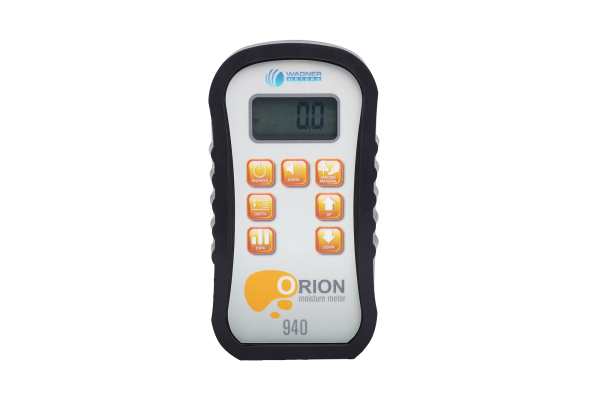
The Orion 940 Data Collection Pinless Wood Moisture Meter Kit features the Orion 940 meter, designed for measurement of moisture content from the surface down to .25” (6.4mm) or .75” (19mm) deep inside wood or other materials. The Orion 940 Moisture Meter also features data collection and storage capabilities vital to Quality Control and home or property restoration applications.
Price: $499
Orion 940 Kit Includes:
- Orion 940 Wood Moisture Meter
- Paired On-Demand Calibrator
- Rubber Protective Boot
- Foam-lined ABS Plastic Carrying Case
- 9V Battery
- Species Settings Booklet
- Instruction Manual
- Common Flooring Materials Settings Reference Card
Orion 950 Smart Pinless Moisture Meter
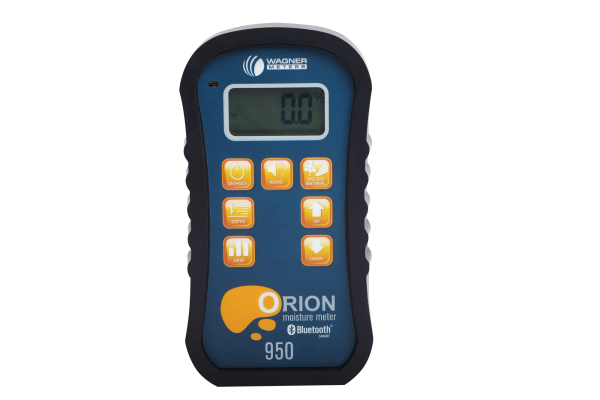
The Orion 950 Smart Pinless Wood Moisture Meter Kit is the all-in-one solution for busy professionals desiring superior accuracy and multi-tool functionality. The Orion 950 features an on-board Equilibrium Moisture Content (EMC) calculator, Bluetooth connectivity to free smart device apps, built-in temperature/RH sensor, and more.
Price: $539
Orion 950 Kit Includes:
- Orion 950 Wood Moisture Meter with Built-in Temperature/RH Sensor
- Paired On-Demand Calibrator
- Rubber Protective Boot
- Foam-lined ABS Plastic Carrying Case
- 9V Battery
- Species Settings Booklet
- Instruction Manual
- Common Flooring Materials Settings Reference Card
Amazon User Reviews
Great moisture meter and more. – 5.0 out of 5 stars
Reviewed in the United States on August 29, 2020
I have a saw mill and a woodworking shop. In the past, I simply let wood dry a couple of years in a barn. I bought the meter so I could shorten that time. What I like about the 950 is that it calculates the theoretical equilibrium moisture content. That is, for the temperature and humidity conditions where the wood is stored, what would the lowest moisture to which the wood can dry. With this info, I can increase temperature and/or decrease humidity to reach my target moisture content in a shorter time.
Best meter I’ve ever used – 5.0 out of 5 stars
Reviewed in the United States on May 16, 2020
I have used several meters. This is by far the best and most versatile. Customer support is fantastic; I used them for help with measuring various materials such as SPF hardwood and OSB subfloor. I would consider no other. There are much cheaper meters on the market; however, if you’re in the market for a meter you are only in the market for an accurate meter.
MMC205 Digital Shopline by Wagner Meters
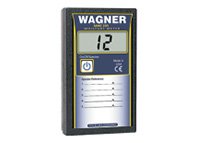 The MMC205 is designed for flooring installers and hobbyists working with woodworking applications involving common softwood and hardwood species that don’t require precision tenth-of-a-percent measurement. Various wood species settings can be selected, helping to eliminate correction table referral after readings are taken. This unit is not affected by temperature or surface moisture.
Price: $280.00
MMC205 Features:
- IntelliSense™ technology
- Moisture content 5-20%
- Programmable species settings
- Wood thickness from 0.75 in. to 1.5 in.
- Select species setting
- Battery included
- Soft vinyl case included
- Reference library CD included
- Weight: .37 lbs.
- Size: Length – 4 9/16″; Width – 2 3/4″; Height – 1 1/16″
- 7-year warranty*
*Warranty includes all MMC and MMl Wagner moisture meters manufactured after Jan 1, 2012.
Benefits:
- More accurate and 10 times faster than pin-style meters
- Wagner meters are designed to give stable readings, eliminating worry of drifting numbers
- Meter will maintain accurate calibration when maintained properly
- One button control (on/off and species settings) makes unit faster and easier to operate
- Scans wood in seconds, providing quick and accurate moisture measurement without damaging wood
- Lightweight and easy to carry so you can negotiate tight areas and obtain accurate readings
- Accurate readings help eliminate callbacks, saving time and money
- Manufactured and supported in the United States with a risk-free 7-year warranty
MMC205 User Reviews:
Does the Best Job without Breaking the Bank
Bob Feeser from Springfield, PA prefers using the MMC205 because it measures moisture content 3/4 of an inch into the wood. He found that surface moisture that varies with humidity in the air is never a factor and doesn’t play havoc with the unit. He also found the booklet included with the MMC205, listing different wood types, to be extremely convenient because it eliminated the hassle of calculating for different wood species. He stated that if he was in the market for another wood moisture meter, he would buy this one all over again!
You can read his review here.
Compact Unit Provides Concise & Accurate Readings
Alfred C. from Concord, MI claims the Wagner MMC205 has come in handy by helping him back up his argument with pricing on supposedly kiln-dried lumber. It’s much easier to negotiate price and prevent price gouging when you have the evidence in the palm of your hand. He finds this unit complements wood shops and serious professionals.
Read the review here.
Helps Prevent Flooring Disasters
R. Saylor from Oregon blindly trusted his lumber provider to supply him with accurate moisture content measurements…until the wood flooring he purchased and installed shrunk by as much as 1/8 of an inch! Now he depends on his MMC205 to provide him with quick and accurate information before he picks up his lumber. Now he feels more confident that he is a better judge of wood materials.
Read his review here.
Should Be a Must for Every Woodworker
Elliot Gesang thinks the Wagner MMC205 is a handy and accurate moisture meter that should be a must for every woodworker. His meter helps him determine when his wood is down to his desired moisture range between 6-7%.
Read his review here.
Unit Is Older but Still Accurate after All these Years
KT still finds his older unit accurate and dependable after owning it for a few years, and highly recommends this unit to other woodworkers.
Read his comments here.
MMC210 Digital Proline
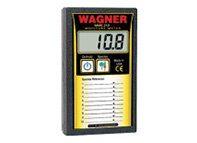 The MMC210 is designed for flooring installers and manufacturers, cabinet and furniture manufacturers, and lumber suppliers and inspectors. This moisture meter is ideal for woodworking applications that specify common softwood and hardwood species, and is recommended when applications include harder tropical wood species.
Price: $375.00
MMC210 Features:
- IntelliSense™ technology
- 5-32% moisture content
- Programmable species settings
- Sensing area 1.5 in. x 2.5 in.
- Wood thickness from 0.75 in. to 1.5 in.
- Select species setting
- Battery included
- Carrying case included
- Reference library CD included
- Shock resistant
- Weight: .37 lbs.
- Size: Length – 4 9/16″; Width – 2 3/4″; Height – 1 1/16″
- 7-year warranty*
*Warranty includes all MMC and MMl Wagner Moisture Meters manufactured after Jan 1, 2012
Benefits:
- More accurate and 10 times faster than pin-style meters
- Wagner meters are designed to give stable readings, eliminating the worry of drifting numbers
- Meter will maintain accurate calibration when maintained properly
- Two-button controls makes unit faster and easier to operate with one hand
- Press and Hold feature allows you to get into tight areas without requiring a visual line to meter display
- Scans wood in seconds, providing quick and accurate moisture measurement without damaging wood
- Lightweight and easy to carry
- Manufactured and supported in the United States with risk-free 7-year warranty
- Shock-resistant model stands up to rugged conditions
MMC210 User Reviews:
User-Friendly Unit Adjusts to Different Species Easily
Stewart Michelon from Medford, OR was impressed with the unit’s packaging and user-friendly interface that makes adjusting for different species easy.
Read his review here.
Accurate and Easy to Use
F. Smith from Nashville, TN finds his meter accurate and easy to use when he routinely checks moisture content on an average of 15 different species.
Read his review here.
MMC220 Extended Range
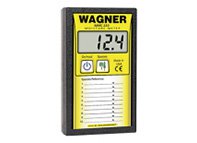
The MMC220 is designed for flooring installers, manufacturers (cabinet and furniture), and lumber suppliers and inspectors. This moisture meter is Wagner Meters’ most popular meter, ideal for measuring moisture content in all wood species, including rare tropical species and common softwoods and hardwoods.
Price: $395.00
MMC220 Features:
- IntelliSense™ technology
- Extended range including tropical species
- 5-32% moisture content
- Programmable species settings
- Sensing area 1.5 in. x 2.5 in.
- Wood thickness from 0.75 in. to 1.5 in.
- Select species setting
- Press and Hold reading feature
- Shock-resistant carrying case
- Battery included
- Reference library CD included
- Weight: .37 lbs.
- Size: Length – 4 9/16″; Width – 2 3/4″; Height – 1 1/16″
- 7-year warranty
Benefits:
- More accurate and 10 times faster than pin-style meters
- Wagner meters are designed to give stable readings, eliminating worry of drifting numbers
- Meter will maintain accurate calibration when maintained properly
- Quickly and easily use the Press and Hold feature under a sink or overhang to take MC readings that stay on display
- Scans wood in seconds, providing quick and accurate moisture measurement without damaging wood
- Lightweight and easy to operate
- Extended SG capability
- Manufactured and supported in the United States with risk-free 7-year warranty
- Shock-resistant carry case protects unit and helps prevent repairs
MMC220 User Reviews:
Easy to Calibrate for Any Species
Gilbert F. McCulley from Mooresburg, TN visited the Wagner team at its Atlanta 2002 show and brought sawmill lumber with him. After testing the sawmill lumber with the MMC220, he was impressed with how easy it was to calibrate the unit. He also appreciated the fact that holes were not left in the wood. He thought this unit was one of the best hand-held meters that he tested.
Read Gilbert’s comments here.
Great to Use on Difficult Lumber
D. Stokes doesn’t know how he lived without the MMC220! He finds the unit easy to use with the exotic and imported woods he regularly uses. In his opinion, the unit is one of the best he has ever seen.
Read his review here.
Accurate Moisture Meter Ensures Trouble-Free Installations
Malcom from Scottsdale, AZ depends on his unit to check materials before he receives shipment. He finds peace of mind with the accuracy of the MMC220 that helps ensure trouble-free installations.
Read his review here.
Consistent Performance from a Fine Instrument
W. Rippel from Ohio commends Wagner for creating such an excellent product that performs consistently. He wouldn’t expect less from such a fine instrument.
Read his review here.
BI2200 Building Inspection
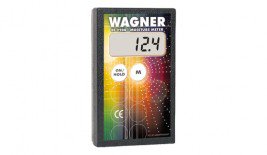
The BI2200 is designed for QC personnel (building or home inspectors) who depend on quick and accurate readings. This moisture meter is designed to measure a wide range of materials including wood, plaster, drywall, stucco, insulation, ceramic tile, linoleum, shingles, concrete, and other materials.
Price: $345.00
BI2200 Features:
- Programmable for many different types of building materials
- Auto power shut-down (60 seconds)
- Moisture content 5-32%
- Protective coating on sensor plate
- Sensing area 1.5 in. x 2.5 in.
- Wood thickness from 0.75 in.
- Select species setting
- Press and Hold reading feature
- Shock-resistant carrying case
- Battery included
- Weight: .37 lbs.
- Size: Length – 4 9/16″; Width – 2 3/4″; Height – 1 1/16″
- 1-year warranty
BI2200 User Reviews:
Meter Was Correct When Expert Wasn’t…Saved Client $5,000!!
Tanker from TN, USA was impressed when his unit saved his client $5,000 right out of the box by dodging bad advice from an expert advising him to tear down a wall to remove water. His meter saved the day, and his bank account!
Read his story here.

Lignomat Moisture Meter Models
Ligno-Scanner SDM
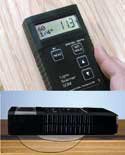
The Ligno-Scanner SDM provides moisture readings for wood and bamboo. A scale is provided to evaluate moisture content in sheetrock and concrete. Reference scales are also available for other building materials.
Price: $307.00
Ligno-Scanner SDM Features:
- Measuring range 5.4-61%
- Measuring depth ¼” and ¾”
- Resolution of read-out: 0.1%
- Carrying Case
- Battery included (9 volt)
- Weight: 8 oz.
- Size: ½” H x 2” L x 5” W
- 2-year warranty
Ligno-Scanner SDM User Reviews:
Consumers have not left positive feedback for device at this time.
Ligno-Scanner D
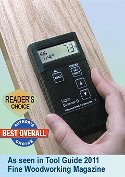
The Ligno-Scanner D is a non-invasive moisture meter made for wood and used mostly by floor installers, furniture manufacturers, and cabinetmakers.
Price: $210.00
Lingo-Scanner D Features:
- Measuring range for wood 5.4-60%
- Measuring depth ¾”
- Range of specific gravity 0.3-1.0
- Species corrections for 71 settings
- Reference scale available for laminates and other composites
- Carrying case
- Battery included (9 volt)
- Correction chart
- Weight: 8 oz.
- Size: 2 1/4” W x 4 3/4” L x 1” thick
- 2-year warranty
Ligno-Scanner User D Reviews:
Consumers have not left positive feedback for device at this time.
Ligno-Scanner SD
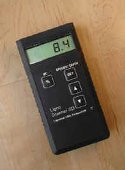
This non-invasive unit is a dual depth (¼” or ¾”) pinless capacitance-type meter. This moisture meter produces a reading that is the average value of area between the surface and maximum depth of penetration.
Price: $289.00
Ligno-Scanner SD Features:
- Measuring pad dimensions 1 5/8” x 2 5/8”
- Size 1/2” H x 2” L x 5” W
- Weight 8 oz.
- Measuring range 5-99% dependent upon species
- Measuring depth ¼” and ¾”
- Range of specific gravity 0.3-1.0
- Wood temperature correction not necessary
- Carrying pouch
- Battery included
- 2-year warranty
Lingo-Scanner SD User Reviews:
Convenient, Accurate, and Easy to Use
Bill Honaker found the results he measured with the Lignomat SD to be consistent with other meters. He enjoys the portability and the user-friendly experience.
Ligno-Scanner S
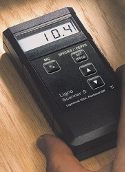
The Ligno-Scanner S is a non-invasive moisture meter calibrated to measure stacked veneer or boards that are less than ¼” thick. Built-in corrections are available for different species. This meter is well-suited to measure moisture that is close to the surface. (Checking finishes between applications.)
Price: $210.00
Lingo-Scanner S Features:
- Measuring range for wood 5.4-60%
- Measuring depth ¼” deep
- Range of specific gravity 0.3-1.0
- Species corrections for 71 settings
- Reference scale available for laminates and composite wood products
- Carrying case
- Battery included (9 volt)
- Weight: 8 oz.
- Size: ½” H x 2” L x 5” W
- 2-year warranty
Ligno-Scanner S User Reviews:
Consumers have not left positive feedback for device at this time.

Delmhorst Moisture Meter Products
ProScan
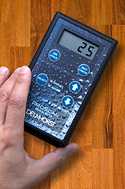
This unit is ideal for furniture manufacturers, flooring installers, inspectors and lumber suppliers. The ProScan uses radio frequency to measure moisture content on a wide range of wood types.
Price: $395.00
ProScan Features:
- Measures MC in range of 5-30%
- Measuring depth ¾”
- Range of specific gravity .30-.80
- 0–100 reference scale for non-wood materials
- Adjustable alarm
- Rugged carrying case
- Battery included (9 volt)
- Weight: 8.5 oz.
- Size: 5 5/8” x 3 5/16” x 1 1/4”
- 1-year warranty
Benefits:
- Quickly scan large areas with dependable results
- Scans without damaging wood (no pin holes)
- Easy-to-read display
- Lightweight and easy to operate
- Rugged construction for accurate results
Delmhorst ProScan User Reviews:
Consumers have not left positive feedback for device at this time.
Delmhorst TechScan
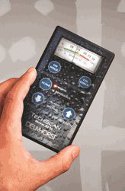
This pinless wood moisture meter is designed for flooring installers, home inspectors, and restoration professionals who need a fast and accurate non-destructive method of checking for moisture.
Price: $375.00
TechScan Features:
- Measures MC in range of 5-30%
- Measuring depth ¾”
- Reference scale – 0-100 color-coded reference
- Temperature range -4°F to 158°F/-20°C to 70°C
- Plastic carrying case
- Battery included (9 volt)
- Weight: 8.5 oz.
- Size: 5 5/8” x 3 5/16” x 1 1/4”
- 1-year warranty
Benefits:
- Quickly scan large areas with dependable results
- Calibrated to minimize false high readings
- Scans without damaging wood (no pin holes)
- Easy-to-read analog display
- Lightweight and easy to operate
- Takes readings in hard-to-reach areas
- Rugged construction for ultimate protection
Delmhorst TechScan User Reviews:
Consumers have not left positive feedback for device at this time.
Conclusion:
The moisture meters we compared in this article seem to have similar features, benefits, and pricing, but no other company seems to offer such an aggressive and comprehensive 7-year warranty as Wagner Meters.
For over 50 years, Wagner Meters has earned the reputation of being one of the most respected world leaders in moisture meter management solutions by designing quality products you can trust and customer support you can rely on.
12 Comments
Submit a Comment
Committed to your search for quality lumber and wood products and the successful completion of woodworking, installation, and inspection projects through the use of moisture meters.
I am a homeowner. One of my bedrooms has developed a musty smell in the last year. A contractor inspected a former leaking window which was fixed 6 yrs ago in addition to all other windows in the room both from the inside and outside. He found no signs of moisture penetration. He also crawled under the house and found no signs of moisture beneath the bedroom or its surrounding bathrooms. He says the only way of finding the source of smell may be to open up walls.
I am thinking of buying a moisture meter. Which would you recommend?
I’d recommend a good pinless moisture meter so you’re not patching holes all over as you hunt for your moisture issue. A leak 6 years ago shouldn’t be just now causing a problem unless there’s a new moisture issue – either in the form of liquid moisture getting in, or high RH (relative humidity) levels in the air. Get a meter with either a relative mode or a drywall specific mode, and take a reference reading on the same material somewhere you know is dry, and compare everything to it. Once you find your elevated moisture levels, and verify there’s not some metal throwing off the readings right behind the drywall, you know what to talk to a contractor about. Best of luck!
Regarding MC in building materials, I was in a 100 year old home, located in a cold climate (Toronto Canada) and the roof deck had rough sawn dimensional lumber planking I assumed was a spruce, but could have been pine. Some of the boards were replaced on a recent re-roof with newer white pine. There was frost on the wood sheathing int he attic and the MC for the old wood was 40MC whereas the new wood was at 20MC.
Does really old (1oo years) dried in a hot attic every summer, with pitch chased out by heat have the capacity to absorb more moisture? I’d love to send pics. I used a pin type meter (cheap bastard I know!)
As wood is hygroscopic, yes, it can absorb moisture. But I’ve never heard of it absorbing moisture to that level – past fiber saturation. I’m very confident that isn’t what actually happened.
A much more likely scenario – pin meters are extremely sensitive to temperature. It’s a huge problem. So you likely just got extremely inaccurate readings from your pin moisture meter. If it was that cold, you likely also got inaccurate readings on the new wood, too. Moral of the story? Get a quality pinless moisture meter (as the cheap ones can be sensitive too). Or if that’s not an option, get a high-end pin moisture meter, take temperature readings, and use the temperature correction charts that a quality manufacturer will supply with the meter. Best of luck, and thanks for sharing the story!
Hi,
I gather there a few pin tip meters on the market which people use for testing the MC of logs. However, I also understand from various reviews that readings are not always accurate or / and that the pins break after regular use, rendering the meter useless or damaged so much that it has to be replaced after a year or so. I also gather that these meters require the pins to be driven-in at least 5mm into the surface, which is often very difficult if one wishes to burn hardwood such as oak.
Through your experience and knowledge of the market are you able to recommend an appropriate meter suitable for testing the MC of hardwood logs to be used in a wood burning stove?
Regards,
John
Hi John,
I don’t have personal knowledge of Firewood Moisture Meters but I have found some blog posts and links that might help you or where your question might be able to be answered.
http://www.hearth.com/talk/threads/cheap-firewood-moisture-meters-which-one.82536/
http://burndryfirewood.com/
http://americanwoodworker.com/blogs/reviews/archive/2011/11/02/moisture-meters.aspx
http://www.whatsbestforum.com/showthread.php?3218-Cheap-but-good-moisture-meter
I hope some of these will be helpful to you.
Best Regards,
Admin
Hi there
Do you know where I can find good non-invasive Moisture Meters foe concrete ? I heard Tramex has some but can’t find anything on internet. Any suggestions ? Would you recomend Tramex ?
Thanks
Adam
What are you planning on using the concrete moisture meter for? Wagner has an article about the different types of concrete meters, but the conclusions would likely also apply to Tramex.
I’m looking to measure the mc of veneer that has been laid up on an mdf core. I’m guessing from what you wrote that the Wagner L607 would be the one for me.
Thanks in advance.
Paul
Paul,
The Wagner L607 is designed specifically for finely sanded surfaces – and your application seems to qualify. That meter also is designed to include shallow-depth moisture in it’s readings – which is what you’ll want for a veneer.
Finally, you could get a pin moisture meter, but I’d recommend against it. They’re just too easy to fool and too inconvenient.
Edit: The new Orion Line of moisture meters from Wagner Meters would be a great option for you – particularly the Orion 930 with its dual depth modes.
Need instructions for Model L601-3 hand-held moisture meter. Actually all I need is the Hardwood Species Adjustment Table. Could they be e-mailed to me?
I believe you’re looking for the Wagner website over here.
http://www.wagnermeters.com/manuals.php
Best of wishes. By the way, feel free to send in a review of that meter or any other other you use, and let the woodworking community know your opinion! (Including a name and link to your website would be optional.)